
PEG-MGF
Showing 13–14 of 14 results
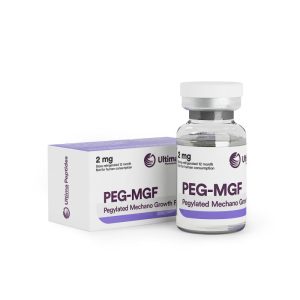
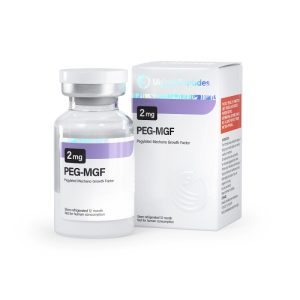
Showing 13–14 of 14 results
PEG-MGF is a modified splice variant, not a separate hormone
Mechano growth factor is a splice variant of IGF-1 produced by muscle in response to mechanical loading and damage. It is a local repair signal, released where the damage happened. This section holds 14 lines from £43 to £178, averaging near £81.
The PEG prefix denotes pegylation — attaching polyethylene glycol to the peptide to slow its clearance.
What pegylation does
Native MGF has a half-life measured in minutes. That is appropriate for a local signal: produced at the site of damage, acting there, then gone. Pegylation extends that dramatically, from minutes to a considerably longer window.
This is a genuine and well-understood technique used across pharmaceuticals. It reliably extends half-life.
The contradiction worth thinking about
Here is the part that is rarely addressed. MGF’s biological role is local and transient — a signal that says “repair damage here, now”. Pegylation converts it into a long-acting compound circulating systemically.
Extending the half-life of a signal whose function depends on being brief and local does not straightforwardly amplify its effect. It may change what the signal means. Whether pegylated MGF still does what native MGF does is not established, and the marketing generally assumes it does without addressing the question.
Against IGF-1 LR3
IGF-1 LR3 is the better-characterised option in this space and is also modified for extended action. MGF’s distinct claim is the local repair role rather than general anabolic signalling, which is exactly the property pegylation puts in question.
Both sit within the wider peptides range and neither is suppressive, so no PCT is required.
Handling
Lyophilised on arrival, reconstituted with bacteriostatic water, refrigerated once mixed. Not a licensed medicine in the UK and prohibited in sport. Verification guidance is in how to check a brand is genuine.
What the underlying research actually showed
The muscle biology behind MGF is genuine. Work from the 1990s onward established that mechanical loading triggers a specific IGF-1 splice variant involved in activating satellite cells and initiating repair. That is well-supported science.
The step from “this molecule participates in muscle repair” to “injecting a modified version improves recovery” is the one nobody has demonstrated. The first part is textbook; the second is inference, and the products are sold on the second.
Frequently asked questions
What does the PEG in PEG-MGF mean?
Polyethylene glycol attached to the peptide to slow clearance and extend half-life.
Is MGF the same as IGF-1?
It is a splice variant of it, with a local repair role rather than general anabolic signalling.
Does pegylation make it more effective?
It makes it last longer. Whether a longer-lasting version of a deliberately brief local signal works better is unestablished.
Is it suppressive?
No. It does not act on the androgen axis and needs no post cycle therapy.
How does it compare with IGF-1 LR3?
LR3 is better characterised. MGF’s claim rests on a local repair role that pegylation complicates.


