Mesterolone
Showing 1–12 of 41 results







Showing 1–12 of 41 results
What Proviron actually does
Proviron is mesterolone, and it is probably the most misdescribed compound in this catalogue. It is commonly called an aromatase inhibitor, a libido drug and a hardening agent. It is none of those exactly. Its main action is binding sex hormone binding globulin, which frees up testosterone you already have. This section carries 41 lines from £36 to £211, clustered near £87.
The SHBG mechanism explains everything else
Most testosterone in your blood is bound to SHBG and biologically inactive; only the free fraction does anything. Mesterolone binds SHBG with high affinity, displacing testosterone and raising the free fraction without raising total testosterone.
| Reported effect | Actual cause |
|---|---|
| Improved libido | More free testosterone acting |
| Harder appearance | Free testosterone plus its own weak androgenic activity |
| Feeling better on cycle | Particularly where a compound has driven SHBG up |
| Bloods look unchanged | Total testosterone is not what moved |
Why it is not an aromatase inhibitor
It has weak anti-aromatase activity, which is where the claim originates. In practice the effect is far too mild to control oestrogen on an aromatising cycle, and anyone using it in place of a proper aromatase inhibitor is under-treating. What it does do — by displacing testosterone from SHBG — is shift the free testosterone to oestrogen ratio, which can feel like better oestrogen control while oestradiol has not moved at all.
It is barely anabolic
Mesterolone is a DHT derivative with very low anabolic activity. It will not build meaningful muscle alone, and a cycle built around it is built around the wrong compound. Its role is supportive — added to improve how you feel and look rather than to add tissue. Judged as a mass builder it disappoints; judged as a support compound it does its job well.
The DHT trade-off
Being a DHT derivative brings the same drawbacks as drostanolone: accelerated hair loss in anyone predisposed, and prostate effects that matter more with age. Finasteride does not counter it, because finasteride blocks conversion to DHT and mesterolone is already downstream of that step.
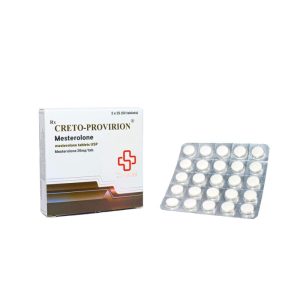
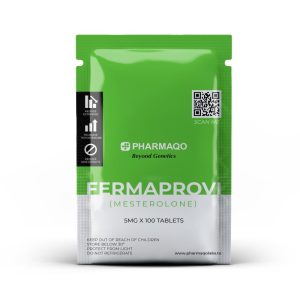
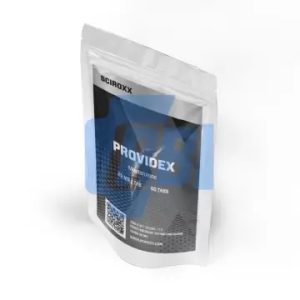
It is also still suppressive. Mild androgenic activity does not mean no suppression, so it belongs in post cycle therapy planning like anything else — it is not a bridge compound and not a recovery aid. Pharmaqo Labs, Ultima Pharmaceuticals and Kalpa Pharmaceuticals carry the deepest ranges, listed as Proviron, Mesterolone, Provix and Provibol at 25 mg. Full detail in what Proviron really does.
Why it is added rather than run alone
Because its own anabolic contribution is minimal, Proviron earns its place through what it does to compounds already present. On a cycle that has driven SHBG upward — common with several oral compounds — a larger share of the testosterone already circulating becomes active, which is why users often describe it as making a cycle “work better” without changing the dose of anything else.
That also explains why it does very little for someone whose SHBG is already low. The effect depends entirely on there being bound testosterone available to displace, which is a genuinely individual variable and one more reason blood work beats protocol-copying.
Frequently asked questions
What is the drug Proviron used for?
Clinically for androgen deficiency. In this catalogue it is used as a support compound, chiefly for its effect on SHBG and the resulting rise in free testosterone.
How fast does Proviron kick in?
The SHBG effect is relatively quick, with subjective changes in libido commonly reported within days rather than weeks.
What are the risks of using Proviron?
DHT-related hair loss and prostate effects, plus suppression of natural production. It is mild on the oestrogenic side, not on the androgenic one.
Does Proviron control oestrogen?
Only weakly. It is not a substitute for an aromatase inhibitor on an aromatising cycle.
Will Proviron show in blood work?
Not as raised total testosterone. Free testosterone rises while total does not, so a total-only panel looks unremarkable — free testosterone and SHBG are the useful measurements.