CJC 1295
Showing 1–12 of 27 results
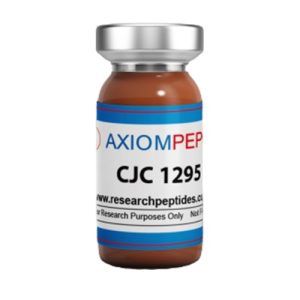
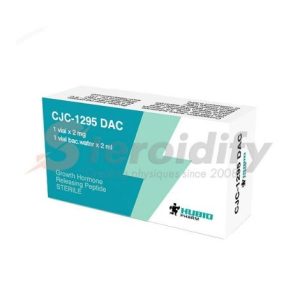


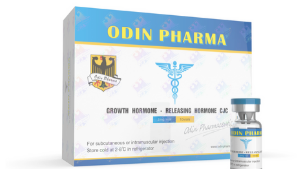
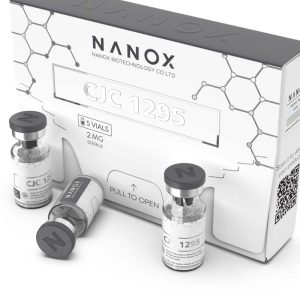

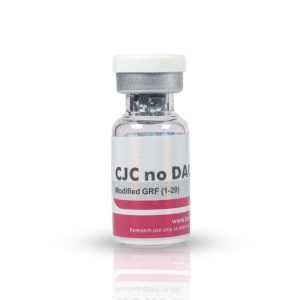
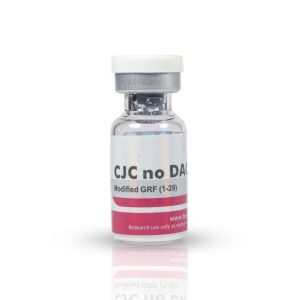
Showing 1–12 of 27 results
What CJC 1295 is
CJC 1295 is a growth-hormone-releasing hormone analogue. It does not supply growth hormone — it signals the pituitary to release more of your own, which is a materially different mechanism from injecting somatropin. This section carries 27 lines from £35 to £650, clustered near £67.
The single most important thing to understand before ordering is that two quite different products are sold under this name.
DAC and no-DAC are not the same product
| With DAC | Without DAC (Mod GRF 1-29) | |
|---|---|---|
| Half-life | Around a week | Around 30 minutes |
| Release pattern | Continuous elevation | Sharp pulse |
| Dosing frequency | Once or twice weekly | Multiple times daily |
| Mimics natural release | No | Yes |
DAC stands for Drug Affinity Complex, a modification that binds the peptide to albumin and extends its half-life from minutes to roughly a week. That sounds straightforwardly better and is not: natural growth hormone release is pulsatile, and continuous elevation is a different physiological signal. The no-DAC version is often preferred precisely because it preserves the pulse.
Why it is usually paired with a GHRP
CJC 1295 and compounds such as ipamorelin or GHRP-2 act on separate receptors — one is a GHRH analogue, the other a ghrelin-receptor agonist. Used together the response is larger than either alone, which is why they are almost always sold and discussed as a pair rather than individually.
Where it sits in the wider range
CJC 1295 is one of several growth-hormone secretagogues stocked, alongside GHRP-2, GHRP-6, hexarelin and sermorelin in the broader peptides section. They divide into two mechanisms — GHRH analogues like this one, and ghrelin-receptor agonists — and the standard approach combines one from each rather than stacking within a class.
What it does not do
It does not exceed what your own pituitary can produce. That ceiling is the mechanism’s safety advantage and its limit — a secretagogue works within your physiology, where exogenous somatropin does not. Anyone expecting HGH-equivalent results from a secretagogue will be disappointed, and pages implying equivalence are overselling. The comparison is in what HGH actually does.
What the research base looks like
Growth-hormone secretagogues have a longer clinical history than most peptides here, having been investigated as alternatives to growth hormone therapy. That work established the mechanism rather than a performance protocol, so the dosing used in this market remains extrapolation rather than evidence.
Handling
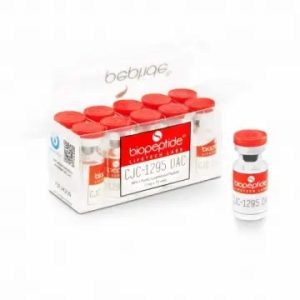
Supplied lyophilised and reconstituted by the purchaser with bacteriostatic water. Refrigerate after mixing; it degrades over weeks and faster at room temperature. Ultima Pharmaceuticals, Euro Pharmacies and Thaiger Pharma carry the deepest ranges, at 2 mg and 5 mg presentations. Check the listing carefully for whether DAC is included — the names are similar and the products are not interchangeable.
Frequently asked questions
What does CJC-1295 do to your body?
It signals the pituitary to release more of your own growth hormone. It does not supply growth hormone directly, which is the key distinction from somatropin.
Is CJC-1295 a steroid?
No. It is a peptide acting on the growth-hormone axis, not an androgen acting at the androgen receptor. The legal position differs accordingly.
Does CJC affect testosterone?
Not directly. It acts on growth hormone release rather than on the reproductive axis, so it neither suppresses nor raises testosterone by that route.
DAC or no DAC?
No-DAC preserves the natural pulsatile release pattern but needs frequent dosing. DAC is convenient but produces continuous elevation, which is a different signal.
Why pair it with ipamorelin?
They act on different receptors, so the combined response exceeds either alone. That is why the two are almost always discussed together.